

Egypt eSIM Guide 2026: What to Know Before You Land
2026-07-27
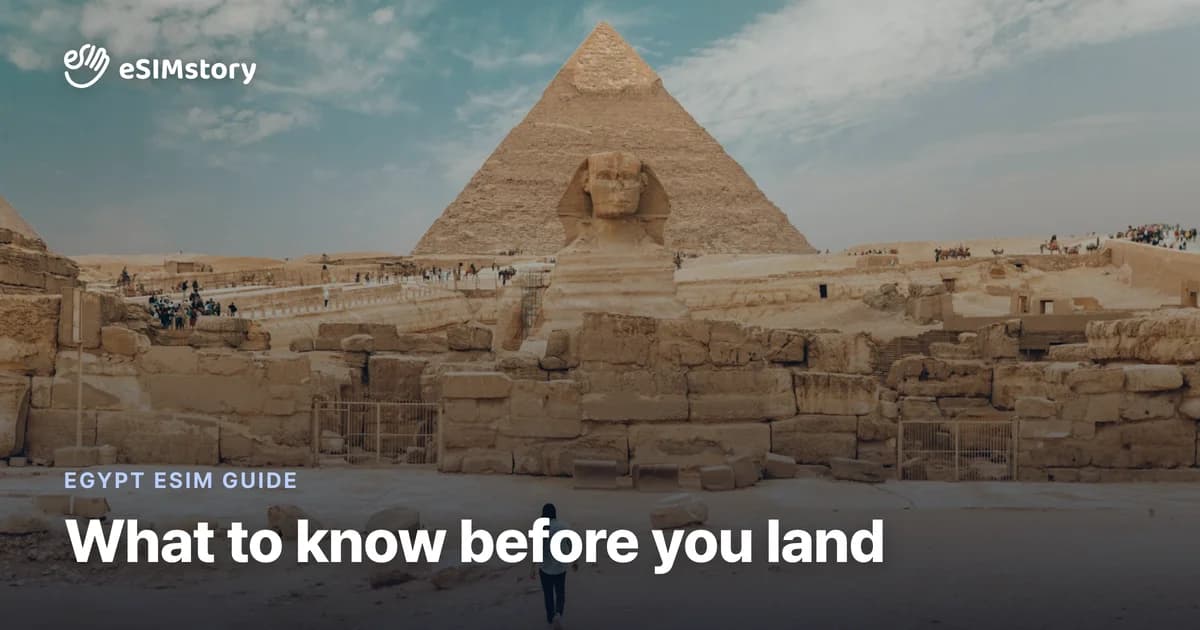
Yes — eSIM works in Egypt, and you can have it running before you leave home. If your phone supports eSIM, you buy a plan online, install it in your kitchen in Sydney or London, and it connects the moment you land. Ours runs on the Vodafone and Etisalat networks, on 4G and 5G.
Which saves you from the other option. Under Egypt's own rules, buying a local SIM card is not a shop transaction. It is a paperwork transaction — and you have to be standing there for it.
Why a local Egyptian SIM means a passport, a branch and a signature
Egypt's telecom regulator (NTRA) spells out what a non-Egyptian has to do to get a local line:
- You must visit a mobile operator branch in person.
- You must hand over your original valid passport plus a document showing you are lawfully in the country, which the agent checks.
- The agent keeps a colour copy of your passport.
- You must be present in person to sign the original paper contract and take your copy.
There is no online path around it. Worse, the rules are written around residency, and a tourist is not a resident — so which document an operator will actually accept from you is something you find out at the counter, in a queue, on your first morning.
Buying an Egyptian eSIM locally is not the way around it either — the rules say nothing about eSIM, so nothing there promises you a shortcut past the passport check. What reliably skips the counter is a travel eSIM bought before you go.
| Local Egyptian SIM | Travel eSIM | |
|---|---|---|
| Where you get it | Operator branch in Egypt | Online, before you fly |
| ID needed | Original passport, colour-copied | None |
| Signature | In person, paper contract | None |
| When it works | After you land and queue | The moment you land |
| Your normal number | Swapped out | Stays active on your main line |
If you have never used one, the beginner's guide to how eSIM works covers the basics in a few minutes.
Do you have to register your phone in Egypt?
For a normal holiday, no.
Egypt taxes imported handsets, and in January 2026 it tightened who is exempt — but tourists kept a 90-day exemption, and the same announcement scrapped phone registration at customs desks entirely. On a two-week trip there is nothing to file and nothing to pay.
If you are staying longer than 90 days, that is a different situation and worth checking against the NTRA notice directly before you travel.
Will you actually have signal on the tourist route?
Mostly yes — with two honest gaps.
Egypt's telecom regulator field-tests the networks every month, and its published testing covers Cairo, Giza, Alexandria, the Delta, the Canal cities, the Red Sea and Upper Egypt. That is the tourist circuit almost exactly: the pyramids, the Nile Valley down to Luxor and Aswan, and the Hurghada coast.
And it holds up: average download speeds in the regulator's own testing run from 48 to 83 Mbps depending on the network. That is more than enough for maps, ride-hailing, messaging and a video call home — you are not going to notice the network.
Gap one: indoors. Thick stone — old hotels, tombs, the inside of monuments — kills signal. Expect bars to drop and lean on hotel Wi-Fi.
Gap two: the desert. Only populated areas and main roads get tested. The Western Desert oasis loop, the road to Abu Simbel, the interior of Sinai and stretches of Lake Nasser are outside that footprint, and nobody publishes coverage for them. Plan as if you will lose signal there.
So download your Google Maps area before you fly, and check it actually saved. Offline navigation works inside the downloaded area, but you lose live traffic, alternate routes and walking directions.
How much data do you really need for Egypt?
Do the arithmetic once and you will stop guessing.
The small stuff is genuinely small:
- General browsing runs about 15–75 MB per hour.
- Maps and GPS navigation use very little data.
- Music streaming is 30–150 MB per hour, depending on quality.
The big stuff is what decides your plan:
- Standard-definition video: about 700 MB per hour.
- High-definition video: about 3 GB per hour.
- A one-to-one video call: up to 1.5 GB per hour. A group call, far more.
So a realistic Egypt day looks like this. Maps to the Egyptian Museum, a few searches, messaging the group chat, booking rides, posting a handful of photos — that is comfortably under 200 MB. Add one ten-minute HD video call home and you add roughly another 250 MB. Start streaming a show from the cruise deck and a single hour eats more than the whole rest of the day.
The rule of thumb: your itinerary does not set your data size. Video does. If you are not streaming or video-calling daily, Egypt is a light-data trip.
That is where the plan structure matters. On eSIM Story you pick a daily allowance — 500 MB, 1 GB, 2 GB or 3 GB per day — and the number of days separately, anywhere from 1 to 30. The allowance resets each day, so a nine-day trip on the 1 GB tier is nine gigabytes, not one. Competitors sell fixed blocks instead — Airalo's Egypt packages run 3, 5, 7, 10, 15 or 30 days — so a 9-day Cairo–Luxor–Aswan run means paying for 10. Here you buy 9. Work out your daily number from the list above, then match it on the Egypt eSIM page.
Ride-hailing in Egypt: where the apps actually work
In Cairo you will lean on Uber or Careem rather than flagging a taxi, and both need live data to book, track and pay. That is the argument for landing connected: you need it at the kerb, not after you find Wi-Fi.
But do not assume the apps follow you around the country. Uber's official Egypt list covers Cairo, Alexandria and Hurghada — Luxor, Aswan, Sharm el-Sheikh and Marsa Alam are not on it. For those, arrange a hotel transfer or agree the fare before you get in.
Setting it up before you fly
Do this at home, on your own Wi-Fi, at least a day before departure.
- Check your phone takes eSIM. Many recent phones do, but there are traps — our guide on eSIM compatible phones has the device list and the one big exception.
- Buy your Egypt plan and choose your data size and exact number of days on the Egypt eSIM page.
- Install the eSIM while still on Wi-Fi. The full walkthrough is in how to install an eSIM.
- Leave data roaming ON for the eSIM line and OFF for your home line. This is the step people get wrong and the reason surprise roaming bills happen.
- Download offline maps for Cairo, Giza, Luxor, Aswan and anywhere else on your route.
Your home number stays active for banking codes and calls. Only your data moves across.
Egypt eSIM FAQ
Does Egypt have eSIM?
Yes. A travel eSIM bought before you fly works there — ours connects over the Vodafone and Etisalat networks, on 4G and 5G.
Can I use an eSIM in Egypt as a tourist?
Yes, and it is the simplest option. A travel eSIM is bought and installed online, so you never enter an operator branch or hand over your passport.
Will my eSIM work as soon as I land at Cairo airport?
It should connect once you switch off airplane mode, provided you installed it before you travelled. Install at home on Wi-Fi, not at the airport.
Do I need to register my phone with Egyptian customs?
No. Customs cancelled personal phone registration at customs offices, and tourists keep a 90-day exemption from the handset tax as of the January 2026 change.
Do I need a passport to get mobile data in Egypt?
For a local SIM, yes — the regulator requires a non-Egyptian to present an original passport at an operator branch and sign in person. A travel eSIM requires none of that.
How much data do I need for a week in Egypt?
If you are using maps, messaging and social media but not streaming video, a light daily allowance is usually enough. Daily video calls or streaming push you up a tier or two. Use the per-hour figures above and multiply by your days.
Can I keep my normal phone number?
Yes. The eSIM handles data on a second line while your home SIM stays active for calls and texts.
Does an eSIM work in Luxor and Aswan?
Yes — Upper Egypt is inside the area the regulator field-tests every month. Expect weaker signal on desert roads between towns.
Before you close this tab
Egypt is an easy country to be connected in and a slightly annoying one to get connected in. The friction is not the network. It is the counter, the passport copy and the signature.
Sort it before you fly, and the first thing you do in Egypt is find your driver — not find a queue.